
Combine flower purchases across several events
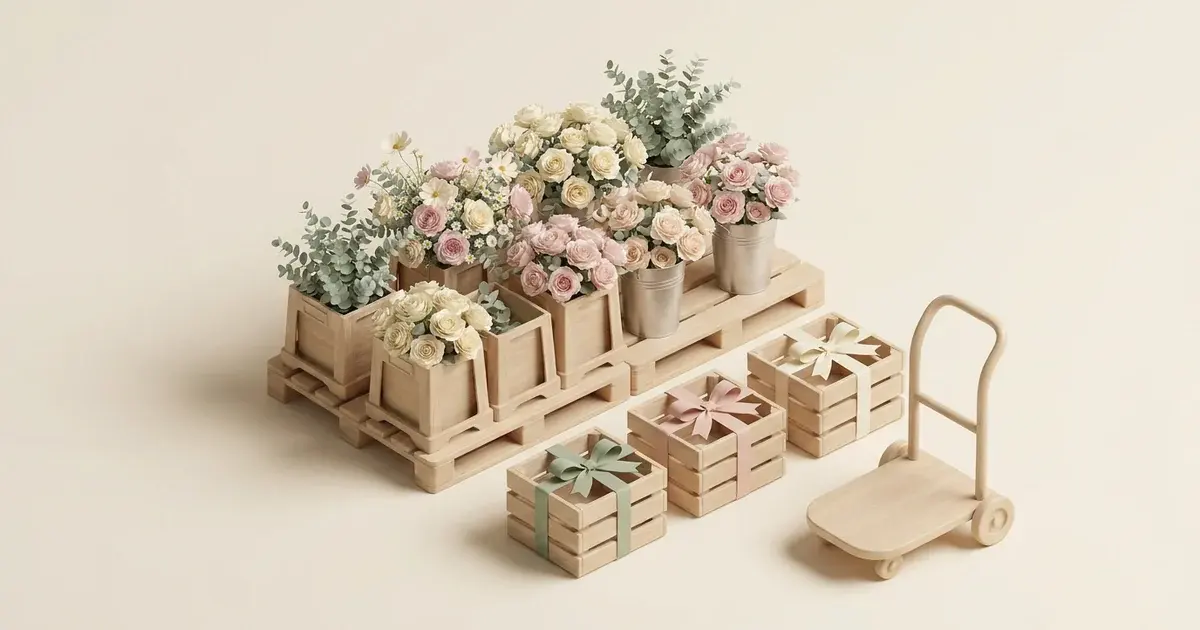
One order for several events: fewer spare bunches, fewer trips, a stock allocated on purpose.
6 min read
Published by FlolyaTo order from the wholesaler when several events fall close together, add up the need for each variety across the whole period, round up to bunches once, then allocate the stock you receive between events. You buy fewer part-used bunches and avoid one trip per event.
Combining only makes sense if the flowers stay fresh until the last event and you know which event each stem is for. Here is a five-step method with a worked example. The quantities are assumptions, not industry averages.
1. Why one order costs less
Cut flowers are usually sold in bunches of a fixed number of stems. If you order event by event, each variety is rounded up to the next bunch every time. Three roundings mean three times the spare stems. A combined order rounds once.
- Fewer spare stems: the rounding to bunches happens once, on the total.
- Fewer trips or orders: one market visit or delivery for the period.
- Larger quantities to discuss with your supplier: ask whether a price or packaging applies above a certain volume, do not assume it.
- An overview: you spot varieties needed by several events and secure their availability.
The downside is real: stock that waits several days keeps less well. Combine for events close together in time, and not for every type of flower (see below).
2. What to combine and what to keep separate
| Type of purchase | Combine? | Why |
|---|---|---|
| Foliage, hardy flowers, supplies (foam, wire, ribbon) | Yes, across the whole period | They keep well and come in bunches or lots |
| Common seasonal flowers (roses, lisianthus...) | Yes, if events are a few days apart | Rounding gain, watch freshness |
| Fragile or fast-opening flowers | Often no: one order per event | Stock loses quality before the second event |
| Rare or pre-ordered varieties | Yes, as soon as the total need is known | The supplier needs volume and lead time |
3. The five-step method
List needs by event and by variety
Start from each arrangement recipe multiplied by its quantity. One row per variety, one column per event.
Add the loss margin you have chosen
Apply it variety by variety, not on the total. A fragile peony does not carry the same margin as eucalyptus.
Add up over the period
Total each variety across all events concerned, then round up to bunches once.
Order and record the allocation
For each variety, write how many stems are reserved for each event. Without this, the first event uses up the whole stock.
Check on delivery
Compare what arrives with what you ordered and check quality. A shortfall is settled the same day, not on the morning of installation.
4. Example: three events over one weekend
Assumptions in this example: three events (A, B, C) from Friday to Sunday, stem quantities already including the loss margin, and a wholesaler selling roses in bunches of 20 stems, eucalyptus and ranunculus in bunches of 10.
| Variety | Stems A / B / C | Total stems | Bunches, 3 orders | Bunches, 1 order |
|---|---|---|---|---|
| White rose (bunches of 20) | 70 / 110 / 45 | 225 | 4 + 6 + 3 = 13 | 12 |
| Eucalyptus (bunches of 10) | 25 / 40 / 15 | 80 | 3 + 4 + 2 = 9 | 8 |
| Ranunculus (bunches of 10) | 32 / 18 / 25 | 75 | 4 + 2 + 3 = 9 | 8 |
| Total | 380 | 31 bunches | 28 bunches |
In this example the single order saves three bunches: one of roses, one of eucalyptus and one of ranunculus. If a bunch of roses costs €24 (hypothetical price), the saving on that variety alone is €24. The saving in value is modest: the real benefit is not multiplying roundings and trips. It grows with the number of varieties and events.
Watch the allocation: the 240 rose stems ordered cover a need of 225. The remaining 15 stems are not a gift, they are the margin you chose to keep or a reserve for the riskiest event. Decide that before ordering.
Calculate the price of an arrangement from its recipe
5. Suppliers, order cut-offs and payment
A combined order is often bigger, so it commits you more. Confirm with your wholesaler its order cut-off times, its cancellation terms and what it will take back. For hard-to-find varieties, order as soon as the total need is known.
Think about payment too. Between businesses in France, the payment term is by default 30 days after receipt of goods, and can be up to 60 days from the invoice date if the terms of sale or the contract provide for it. Read your supplier's terms: they affect your cash flow when a combined order is larger.
6. Mistakes that cancel the gain
- Combining fragile flowers over more than two or three days.
- Forgetting to reserve stems per event, then running short for the last one.
- Applying one loss margin to everything instead of one per variety.
- Changing a variety for one event without recalculating the combined order.
- Ordering before a quote or change is confirmed: do a last check of needs the day before ordering.
In Flolya, flower and supply needs are prepared from arrangement recipes, and the orders space helps you organise your shopping list. It does not order from your supplier for you: you keep control of the final quantity and the split between events.
Prepare purchasing and production from your recipes
Frequently asked questions
- How do I order flowers for several events?
- List needs by variety and event, add them up, round to bunches once, order, then record how many stems are reserved for each event.
- How many days apart can events be and still combine?
- It depends on the variety, quality on delivery and your storage. Foliage lasts longer than fragile flowers: test with your usual varieties.
- Does a wholesaler give a better price on a large order?
- Not automatically. Ask for its terms at a given volume. The surest saving comes from avoided roundings and fewer trips.
- What should I do with spare stems after a combined order?
- Decide their use before ordering: reserve for the most delicate event, loss margin or small pieces. Without a decision they end up wasted.
Prepare your purchases from your recipes
Find the flower needs of your events in Flolya and organise your shopping list.
View pricing30-day free trial, no card required.